
Following the Red Knot: Theatre, Migration and the Politics of Labour
As a theatre practitioner and activist, I have often been drawn to stories that sit at the intersection of art, politics, and lived experience. As we are nearing International Domestic Workers Day, I was revisiting one of the most meaningful projects I have been involved in, The Migrators, a theatre piece developed in collaboration with migrant domestic workers in London. The work emerged from a desire to explore migration not only as a human experience but also as an ecological one, drawing parallels between the journeys of migratory birds and the movement of people across borders in search of safety, survival, and dignity.
The inspiration for The Migrators came from two seemingly different realities. The first was the UK's hostile environment policy, which created increasingly difficult conditions for migrants, particularly migrant domestic workers. The second was the impact of climate change on migratory birds, specifically the red knot, a remarkable bird that travels thousands of miles from Siberia to the Sahara. As environmental conditions shift and habitats disappear, these birds face growing uncertainty along routes that have sustained them for generations.
The more we researched these two stories, the more connections began to emerge. Both migratory birds and migrant workers navigate systems beyond their control. Both are vulnerable to changing environments. Both depend on networks of support, rest, and safety to survive. And both encounter borders—physical, political, and ecological—that determine who belongs and who does not.
For migrant domestic workers in the UK, these borders have been shaped by policy decisions that have profoundly affected their lives. Many migrant domestic workers are employed by wealthy households and brought to the UK to provide care and domestic labour. Yet for many years, changes to immigration policy stripped workers of fundamental rights and protections, leaving them vulnerable to exploitation and abuse.
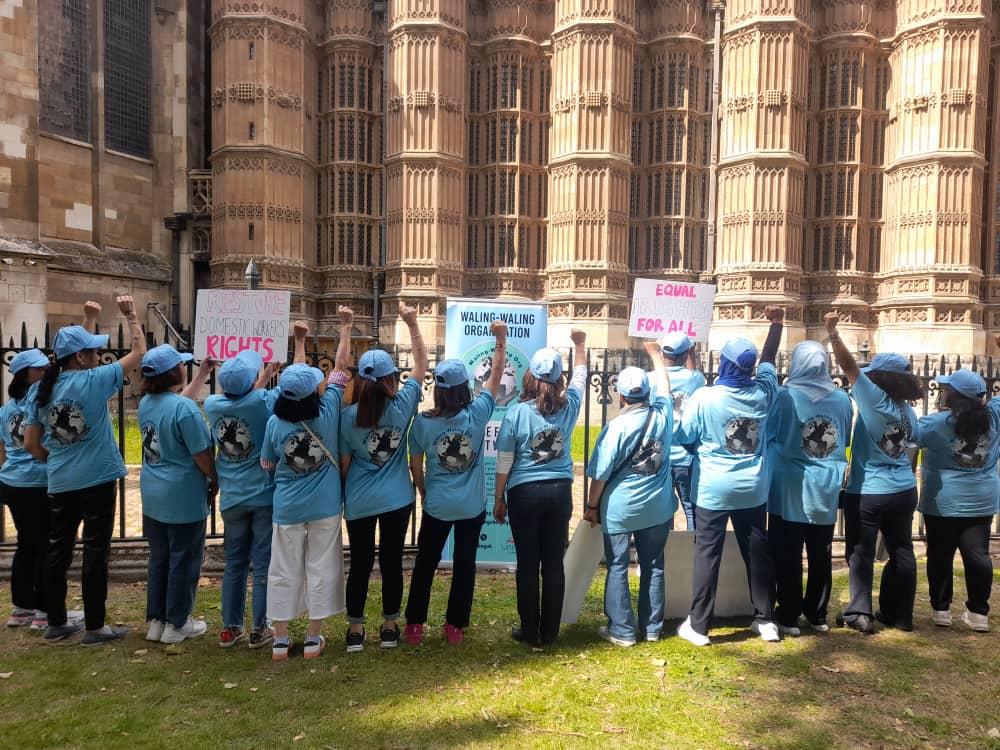
It was through this context that I, together with theatre-maker and our project lead Cheryl Gallagher, began working with Waling Waling, a collective of migrant domestic workers based in London. Waling Waling has a long and powerful history. The organisation emerged in the late 1970s when migrant domestic workers fleeing abusive employers began coming together to support one another. In a society that often rendered them invisible, Waling Waling became a space of solidarity, community, and resistance.
Through years of campaigning, migrant domestic workers and their allies secured a significant victory: the introduction of the Overseas Domestic Worker visa, which granted workers important rights and protections in the UK. For many, it represented recognition of their humanity and labour.
However, these gains were later undermined by changes in immigration policy. Today, Waling Waling continues to campaign for the restoration of domestic workers' rights and for the regularisation of all migrant domestic workers in the UK. Their struggle reminds us that rights won through collective action can never be taken for granted.
When Cheryl and I began facilitating weekly theatre sessions with the group, our intention was not simply to tell stories about migrant domestic workers. Instead, we wanted to create a space where workers could tell their own stories, shape the narratives, and use theatre as a tool for artistic expression and political advocacy.
What followed was an exemplary community theatre work with a group of migrant workers activists who went above and beyond in the process of creating a meaningful advocacy campaign. Over two years, we collectively developed three productions, each rooted in the lived experiences, creativity, resilience, and political insights of the participants. The process was never solely about representation. It was about creating excellent theatre while also building confidence, community, and collective power.
Theatre offered a unique space where personal experiences could be transformed into public narratives. Stories that were often hidden behind closed doors became visible. Experiences of migration, labour, isolation, and resistance were reframed not as individual struggles but as interwoven societal and political systems that enabled a lack of accountability and victimised vulnerable workers.
For me, one of the most powerful lessons from this work has been witnessing the transformative potential of creative practice. Theatre became a place where participants could challenge dominant narratives and reclaim agency over stories that had further disempowered the workers, creating no real change in their labour rights.
This year, we are preparing to present our latest production, Antigone, Reimagined, at Queen Mary University of London as part of International Domestic Workers Day celebration at the Mad Hearts festival. Adapted and performed by the Waling Waling Drama Group, the production reinterprets the classic Greek tragedy through contemporary experiences of collective resistance.
Like The Migrators, Antigone asks urgent questions about justice and the consequences of systems that deny people their rights. It invites audiences to consider who is protected by the law, who is excluded from it, and how communities organise in the face of injustice.
Looking back, The Migrators was never only about birds or borders. It was about movement and survival. It was about recognising the interconnectedness of ecological and social systems, and understanding that the forces shaping migration are rarely individual choices alone.
At a time when migration is increasingly framed through fear and division, theatre offers a different possibility. It creates space for silenced narratives, complexity, and encounter. Through our work with Waling Waling, I have learned that stories do not simply reflect the world as it is—they provoke us to change the world as it could be.
About the author:
This blog is written by Drashti Shah who co-facilitates the Waling Waling Theatre Project.
If you would like to support the campaign by Waling Waling on the restoration of domestic workers’ rights and regularisation of all migrant workers, you can visit their website here.