by Maze Raghavan Cohen
For so many of us, our relationship with nature is essential to our wellbeing. Especially as a disabled neurodivergent person, I have always gone to the land for friendship and refuge.
But disabled land stewardship is often considered an impossibility. Usually when I’ve brought up accessibility and disability justice in land stewardship, I’ve gotten confused looks. The looks precede awkward questions, like “what does disability justice have to do with land stewardship?” And “how could disabled people steward land?”
And yet, these questions reveal the very reasons why disabled land stewardship is hard to find. If land stewardship is inaccessible to disabled people, it's because we’ve designed it that way. Despite abled assumptions, disabled people deserve access to a connection with land, just like abled people. And land stewardship desperately needs disabled wisdom, especially as we steward increasingly sick and dying ecosystems. Most importantly, there are already many disabled people working in land stewardship despite the numerous access barriers.
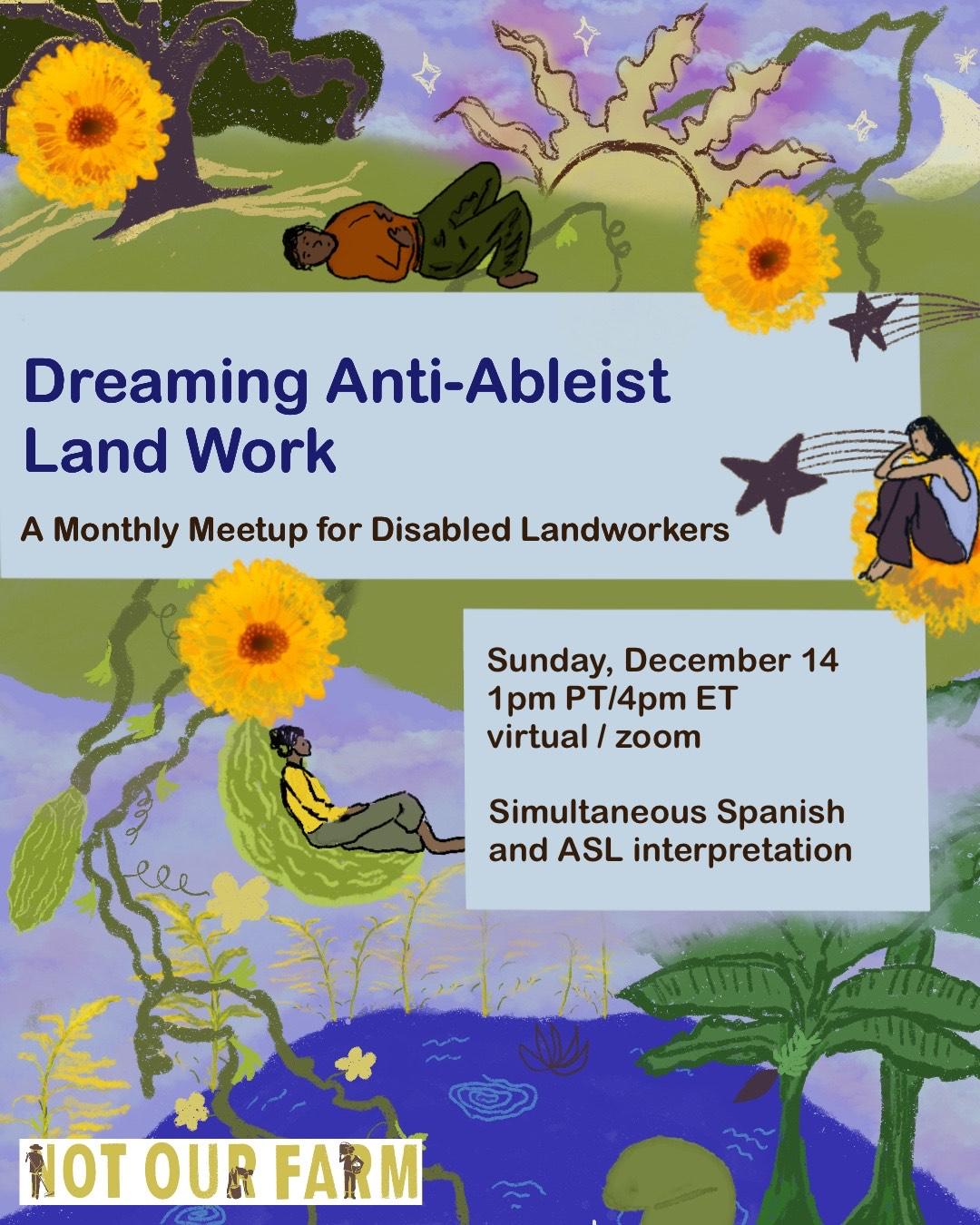
Even though we are many, I have yet to find another space for disabled landworkers to come together. Dreaming Anti-Ableist Landwork is this space - a pilot series of four virtual discussion sessions for disabled landworkers to build community. The group is co-facilitated by Julie Nowak of The Seasonal Body and me, Maze.
I am a farmer who became chronically ill after getting a concussion while farming. The year after I developed chronic illness, I spent months travelling across Turtle Island seeking out accessible land stewardship so I could continue farming. I struggled to find examples. Even though there are many disabled landworkers, we are often working under non-disabled leaders, forced to conform to abled expectations, or excluded entirely from formal land work. It is hard to talk about access or disability justice because there is so much risk and shame in exposing our disabilities. I met many land workers who feel pressure to hide their disability, and many who struggle with chronic health or mental health issues but aren’t comfortable talking about disability.
Yet there is growing momentum for this to change. In December 2024 I attended a session of Not Our Farm’s Free School for Farmworkers called “Farming in an Ableist Society,” hosted by Kristie Cabrera. I was blown away by the massive turnout of around 150 participants, by far the largest for any Free School session.
In the Fall of 2025, Not Our Farm, Julie and I joined forces to create Dreaming Anti-Ableist Landwork - a space where we could continue this conversation about ableism and anti-ableism in land stewardship. The need for the discussion group was immediately confirmed, as dozens of people registered within hours of us publicising the event. Participants encompass a wide range of disabilities and land stewardship practices, from farming to nature education to herbalism. So far we have hosted three sessions - in December, January, and February - and have one more scheduled in March. After this four month experiment, we will reassess our next steps towards organising disabled land workers.
The first three sessions have buzzed with excitement to share our stories, knowledge and questions. We have delved into the barriers we face as disabled land workers - from land access to discrimination from employers; from toxic chemicals to farms that we physically cannot navigate. We co-created a resource guide listing the plethora of strategies we use to do land work in the face of overwhelming obstacles.
We’ve shared what brings us to land work despite the barriers. The medicines we seek from the land. The ways we see ourselves in the injured Earth. The ways that the land holds us even when humans reject us for our needs or our “craziness.” The necessity for everyone to have a relationship with the land, because the land is our family, the source of our power, the source of our resources, both material and immaterial.
We’ve talked about the gifts we hold as disabled land workers. The way our slowness encourages us to observe and move with the land. Our talents in tending injured landscapes. The simple fact that now is a time of mass disablement, meaning that disabled land stewardship is increasingly the only possible land stewardship. Even more so because land stewardship is often disabling, because of injury, stress, chemical exposure, or overexertion.
The sessions are filled with the warmth of simply being together. To be seen and inspired by each other. To have a space to be honest about our experiences. To see that collectively we hold so much knowledge and strength.
What happens after these four pilot sessions will depend on the dreams, needs and capacities of the community that has attended the pilot series. Whatever shape it takes, we know this work will continue. There is clear momentum to build community, increase access to land work, and uplift the voices of disabled land workers. If we’ve learned anything so far, it's that disabled land workers aren’t going anywhere. We are needed, we are resourceful, and we are many.
Maze (they) is a neuroqueer South Asian and Ashkenazi farmer based in Northern New Mexico. After developing chronic illness due in part to many years of farming and organizing in ableist spaces, they have recentered their work to focus on the intersections of disability justice, creative practice, and land stewardship. In all their endeavours, they strive to create microcosms of home and healing. You can find their creative work at a-maze.art.