Akademi's Dance Well programme
by Akademi
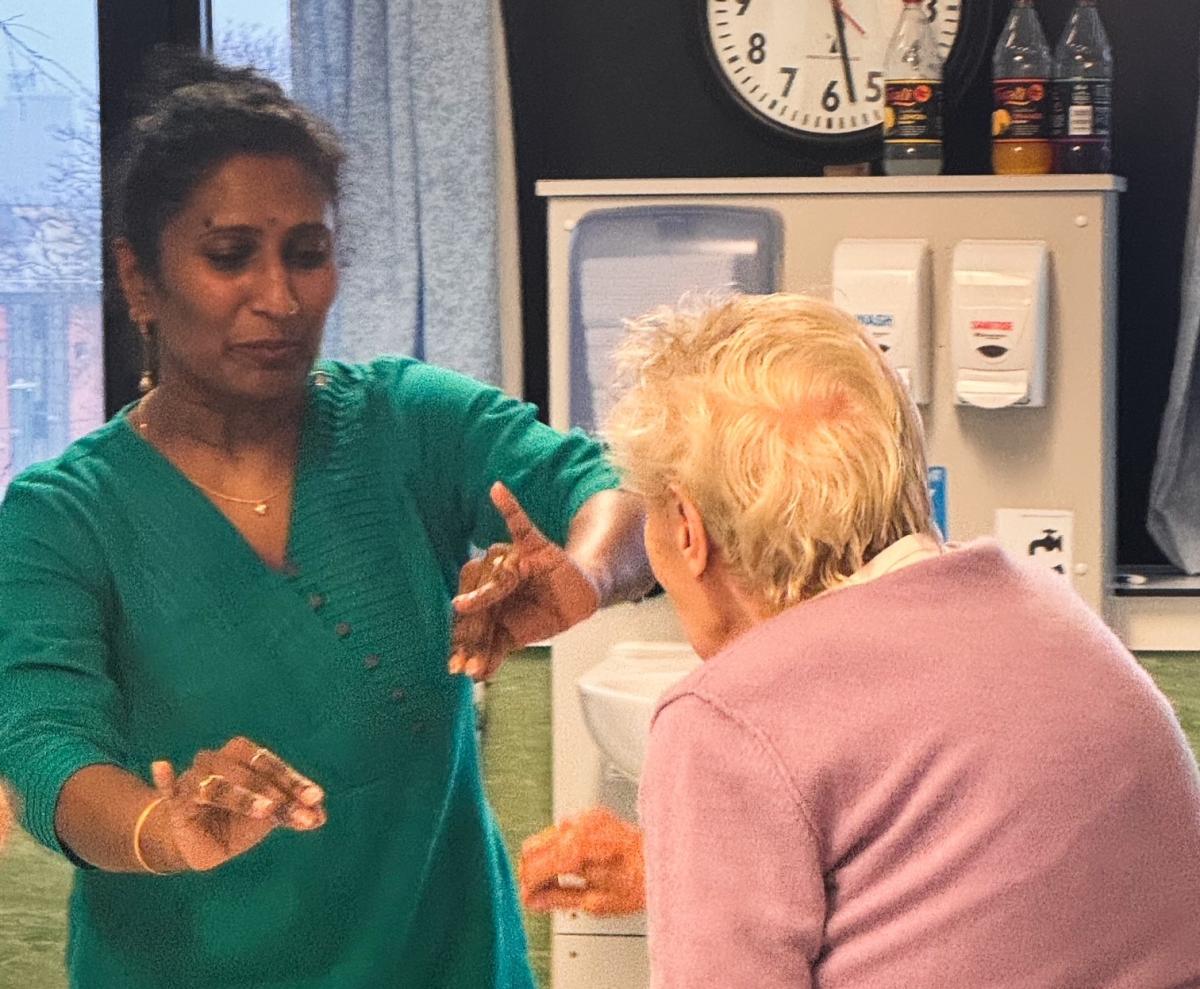
For over two decades, Akademi has been taking South Asian dance into some of London's busiest hospitals, as a genuine part of the patient experience. Our Dance Well programme spans performance and participatory movement workshops/sessions across atriums, wards and bedsides, working with all ages, from children on paediatric wards to older adults living with long-term conditions such as renal rehabilitation and dementia. Our longest-standing NHS partnership, with CW+ Arts charity has run for over 25 years, and we currently work across a network of five hospital nationally - Nottingham University Hospitals NHS Trust (Queen's Medical Centre (QMC) and Nottingham City Hospital), Chelsea and Westminster NHS Foundation Trust(Chelsea and Westminster Hospital and West Middlesex Hospital) , Oxford Health NHS Foundation Trust (Warneford Hospital), University Hospitals Coventry and Warwickshire NHS Trust (University Hospitals Coventry and Warwickshire).
The case for this kind of work is no longer in question. It is a well proven fact that dance offers an evidence-based, joyful route into experiencing art and movement that provides real relief from the mundane and often stressful, clinical environment.
South Asian dance styles, in particular, bring qualities that make them especially well-suited to hospital settings. The intricate hand gestures, or mudras, double as fine motor and hand-articulation exercise. We've found the precise, repeatable movements an effective way into memory and connection for dementia patients when words are harder to reach. That same combination of mudras and storytelling is what makes sessions so effective with younger patients too, holding their attention in a fun and interactive way. And, of course, the rhythm, colour and music of styles South Asian dance forms offer something many patients and NHS staff recognise and connect with culturally, bringing a sense of familiarity and representation into a clinical space that can otherwise feel alienating for an increasingly diverse patient population.
What we're now focused on is a challenge, to build a model that sustains our creative health interventions to take root permanently within the healthcare system, rather than surviving project to project.
In practice, our partnership model works with NHS trusts to support a programme of participatory sessions for patients and staff, with investment shared between the NHS trust and Akademi. Funding from The Linbury Trust enables Akademi to bring in a lead artist, while the NHS trust contributes to the wider delivery. Alongside the programme, Akademi’s training model provides an opportunity for an emerging or supporting artist to learn through observation, mentoring and practical experience alongside the lead artist. Wherever possible, we work with artists who are already connected to the local community, rather than bringing practitioners in from elsewhere. This helps ensure that the relationships, knowledge and skills developed through the partnership remain embedded locally, creating a stronger foundation for the work to continue beyond the initial programme.
What the model looks like
Akademi's approach is focussed on delivering patient and staff participation workshops, , and importantly, building the ecosystem around them. That means cultivating the conditions to sustain hospital partnerships and specialist South Asian dance artists over the long term, not just for the length of a grant or project.
This is a deliberate response to the challenge that even excellent, well-evidenced work often has a short shelf life. Funding cycles end, artists move on due to lack of work opportunities in this field, and institutional memory disappears with them. By investing in training, in relationships with NHS trusts and foundations, and in the infrastructure that sits behind the sessions themselves, we're determined to give this work a longer life.
We are investing in artist training, because delivering dance safely and sensitively on a hospital ward is a specialist skill that most dance training doesn't cover. The artists are developing genuinely niche skills through rigorous, experiential training including reading a room where a patient may be in pain or distress, adapting for physical or cognitive impairment and working alongside occupational therapy and physiotherapy teams. The training doesn't stop once an artist is qualified to deliver sessions, we run ongoing CPD days to keep skills current and relevant and shared across the artist community, and we're preparing to roll out a large-scale training programme in this area soon.
Building this pipeline means we are engaging more artists, especially outside London, opening up job opportunities in a sector where they can be hard to come by.
Why scale matters
Our vision has always been that South Asian dance is for everyone, and a hospital ward is one of the truest tests of that belief. We are reaching people who would never think of dance at some of the most vulnerable moments in their lives. Therefore, at its heart, scaling of this model is about more than growth, it is about fulfilling our charitable purpose. Scaling is also what allows us to diversify our income streams, so this work isn't dependent on any single funder and can withstand the funding cycles that very often cut short effective programmes. Perhaps most importantly of all, it's about strengthening the wider creative health sector, so that culture becomes embedded in patient care and not an occasional bonus.
Since 2019, our hospital programme has engaged with over 7,455 patients and NHS staff across 480 sessions in 12 London hospitals, a scale that only comes from sustained partnership and funding.
We also want our work to sit within the research radar, so it can serve as a template for other organisations looking to deliver into this field, in the same way our the research on Reach Out and Reveal (ROaR) programme in SEND schools has done. The evaluation report from our work at the Royal London Hospital in 2017 has already shown the value of what we do, but we feel that getting this evidence base recognised and built upon is essential.
We invite researchers to study the impact of our hospital work, and we're committed to making those findings accessible by sharing them through our digital channels and open-access platforms. That's why we carry out expert evaluations from time to time, grounded not just in outcomes data but in regular consultation with NHS staff and carers, patient feedback, and our artists' own observations session to session, so the model keeps evolving in response to the people actually residing and working on the wards. We are now embarking on a more rigorous evaluation project from 2026 to 2028 with Breathe Arts Health Research.
The challenges so far
None of this is straightforward. Building a sustainable pipeline of artists able to deliver specialist, culturally rooted work within hospital settings requires sustained and long term investment in artist development, mentoring and monitoring and organisational capacity. This is not simply about increasing the number of artists available; it is about developing the depth of expertise, confidence and contextual understanding needed to work effectively in complex healthcare environments.
Our approach prioritises quality and long-term capacity over rapid expansion, ensuring that artists are appropriately supported as they develop their practice in these settings. While this requires greater investment than a conventional training model, it creates a stronger and more resilient talent pipeline, protects the quality of delivery and supports the long-term sustainability of this work.
Embedding dance into ward routines depends on genuine buy-in from clinical teams and art charities associated with the hospitals. That buy-in is harder to secure when NHS staff and resources are already stretched thin, and creative activity can understandably slip down the list of priorities against more immediate clinical demands.
Building the long-term funding partnerships this model relies on, takes patience and understanding from funders, moving from the framework of a contained, time-limited project to committing to the longer-term investment towards supporting something sustainable
What's next
Looking ahead, we see real scope to develop Dance Well into a genuinely scalable model, that other organisations and trusts could adopt, and that generates the kind of longitudinal evidence the sector needs. However, this can only happen in partnership with NHS trusts willing to commit beyond a single ward or a single year, and with foundations willing to fund the ecosystem.
We started this work believing that South Asian dance is for everyone, and hospitals have taught us just how far that belief can travel - into wards, waiting rooms and bedsides, to people who never expected to dance at all. The next chapter isn't about proving that this works; the evidence for that is already there. It's about building something durable enough to outlast any single grant or project, so that culture stops being a visitor to healthcare and becomes part of how care is delivered.
About Akademi
Akademi has been the beating heart of South Asian dance in the UK, since 1979. They make vibrant, and meaningful work using the compelling power of storytelling, rhythm and gestures. Akademi are known for their world-class dance performances and groundbreaking wellbeing programmes, bringing joy, inspiration and hope to people’s lives.
With a vision that South Asian dance is for everyone, Akademi’s work can be found in everyday places from theatres, shopping centres and festivals to hospitals, care homes and SEND and mainstream schools.
Through its Dance Well programme, Akademi brings performances and workshops to wards, atriums and bedsides in hospitals across London, Oxford, Nottingham and Coventry. It reaches patients of all ages, along with their families, visitors and NHS staff. Akademi's experienced artists lead weekly movement sessions at six care homes and community centres in London.
Since 2019, Dance Well has engaged over 10,000 people where, evaluations have shown measurable benefits to physical and mental wellbeing for patients, residents and staff.
You can find out more about Akademi at www.akademi.co.uk