What have you been doing today?
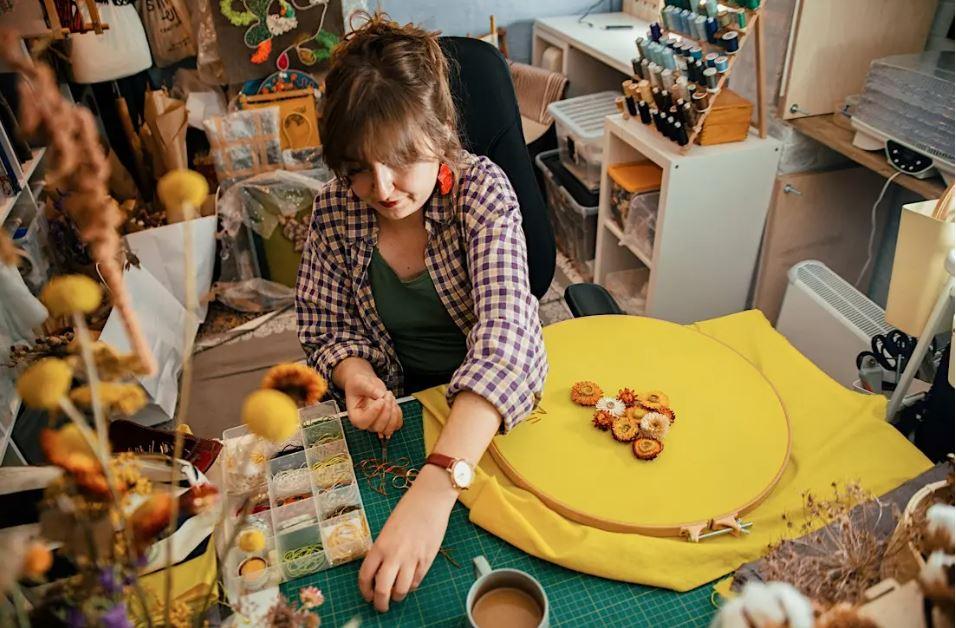
My day began at home over breakfast with Teddy, a delightful Shih Tzu I frequently dog-sit for a friend, before we walk together to my Creative Community Engagement role at Stitch-Up CIC inside Meanwood Community Centre. I work here three days a week blending part-time work with my freelance practice as an embroidery artist and gardener; today I taught young makers aged 7 to 17 how to sew and garden as part of their Healthy Holidays programme. Once my shift wraps up, Teddy and I take a peaceful stroll up to my allotment, where I spend a quiet afternoon, watering, and deadheading the blooms in my flower garden. I end the day back on the sofa, unwinding with a meal, a soothing cup of mint tea, and my husband, Jon.
Is this a typical day for you? Perhaps tell us how your day can vary across your practice.
This typical routine anchors just three days of my week, as the rest of my time fluctuates massively depending on the scope of my freelance projects and community commitments. On any given day, I might be found teaching structured creative courses at Sunny Bank Mills, leading evening workshops at Left Bank Leeds, or travelling across the North of England to facilitate long-term community embroidery projects and retreats. My schedule has diversified even further with the recent launch of my community flower-growing group on Monday evenings, reflecting a fluid lifestyle where I intentionally plan my days around active commissions. To maintain this balance, I frequently shift my weekends—sacrificing a Saturday to teach in a charity, or organisation, while reclaiming a Friday for dedicated "me time" or essential work at the allotment. Amidst delivering these external textile and gardening sessions, I constantly negotiate the calendar to protect that all-important, yet often elusive, studio time to sustain my own creative practice.
How have you made space for your own wellbeing today?
Beyond my professional life, I deliberately make space for my own wellbeing through my allotment, which serves as a vital sanctuary of peace and silence where I can process my thoughts and reset. I protect this time fiercely, making the trip up to the plots every single day if possible, or at least every other day, to tend to the earth or simply slow down. Today, that meant watering, though on other days I might just lie in my hammock or cut a fresh bouquet of blooms to take home. Taking stock after work is an equally essential ritual for me; today, that transition looked like sitting quietly by the window, sipping a warm tea, and recharging with a fresh bowl of watermelon and pomegranate—my absolute favourite ritual to close out a busy day.
When and how did you start working with culture, health and wellbeing? How does this compare to today?
While culture, health, and wellbeing have always been subtly embedded in my practice, the true turning point arrived during the 2020 pandemic when a period of severe ill health triggered my own profound mental health challenges. This crisis forced an absolute paradigm shift in how, why, and for whom I work, ultimately inspiring me to refocus my embroidery practice entirely on health and healing. I began exploring stitch as a powerful vehicle to embellish, connect, and transform myself and communities after isolation—a concept that became the core foundation of my MA by Research. Following this academic and personal breakthrough, I intentionally restructured my practice around the Five Ways to Wellbeing, drawing powerful parallels between the slow, tactile rhythms of embroidery and gardening.
I first channelled this dual passion into managing the Growing Colour Together project with WOVEN in Kirklees in 2023, before transitioning into my current Creative Community Engagement role with Stitch-Up CIC. Today, my creative practice merges horticulture, floral elements, and experimental embroidery techniques to explicitly support mental health and celebrate community resilience. However, when I faced a major, devastating bereavement in 2024, I was once again forced to rethink my relationship with my art, prompting a deeply personal exploration into how a personal creative practice can help process intense grief—a vulnerable new chapter that I am just beginning to navigate with the compassionate support of The Grief Garden CIC.
What was the last project you came across that inspired you and how?
The last project that left me incredibly inspired was The Red Dress project by Kirstie Macleod—a monumental, 14-year global collaborative initiative that united embroidery from 51 countries into a single garment to amplify marginalized voices worldwide. Drawing profound inspiration from this record-breaking global community effort, I have since dedicated myself to collaborating with a diverse range of community groups across Yorkshire to develop textile works that reflect their unique stories, culture, and identity. Through immersive embroidery sessions, I have partnered with the Persian Women's Hub, Shantona Women's Centre, Calderdale Valley of Sanctuary, Hamara, and Leeds Libraries to create deeply meaningful collaborative embroidery pieces centered around the themes of culture and freedom.
Elnaz Yazdani is an embroidery artist, gardener and educator based in Yorkshire. Elnaz is dedicated to sharing her textile skills and promoting the importance of embroidery as an art form for the future and for community wellbeing.
Elnaz has taught embroidery throughout her community, within primary, secondary and higher education as well as community groups and organisations.
In 2020 Elnaz was commended for the teaching excellence award in embroidery via the Embroiderers Guild and became an Embroiderers Guild Scholar after the successful launch of her virtual embroidery school ‘Embroider Your Future’.
In 2025 Elnaz was awarded a Master of Arts by Research in recognition of a programme of work entitled ‘Rethinking Embroidery: Connecting, Embellishing and Transforming Communities Through Embroidery.
Her practice explores ways of transforming traditional embroidery techniques through her choice of unusual materials; she is inspired by industrial materials, nature and with the ways in which she can embellish, connect or transform these items through stitch to develop a surface or form.
Her unique embroidery style has allowed her to work across community groups and organisations exploring the use of embroidery and gardening as a tool for social prescribing. Connecting, Embellishing and Transforming communities through stitch and plants. Exhibiting embroidery work since graduating from her BA at Manchester School of Art in 2014.
Elnaz is available for workshops, talks, embroidery commissions, exhibitions and collaborative projects.